
In hot rolling mills, stable pressure is critical for effective oxide scale removal. A high pressure descaling system must deliver the required pressure and flow at the nozzle, not just at the pump outlet.
When pressure drops inside the system, the water jet becomes weaker. This reduces impact force, affects scale removal, and may leave oxide scale on billets, slabs, blooms, TMT bars, or hot metal surfaces. If this scale enters the rolling stands, it can cause rolled-in scale, surface defects, poor finish, roll wear, and production losses.
PressureJet specializes in engineered steel rolling mill descaling solutions designed to maintain stable pressure, strong nozzle impact, and reliable surface cleaning performance.
What Is Pressure Drop in a Descaling System?
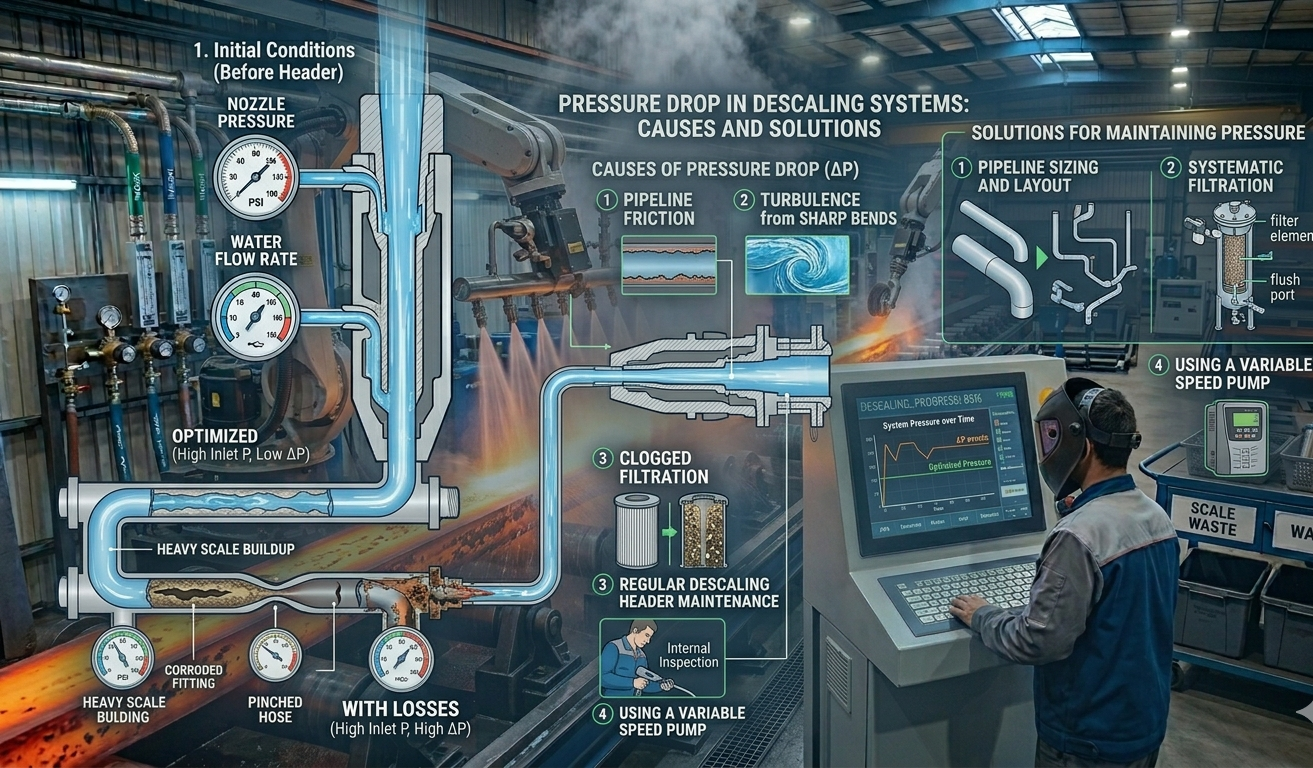
Pressure drop means loss of pressure between the high-pressure pump and the descaling nozzles. Some pressure loss is normal because water passes through pipes, bends, valves, filters, fittings, and headers.
However, excessive pressure drop is a serious problem. In a rolling mill descaling system, the most important pressure is the pressure available at the nozzle. If nozzle pressure is low, the water jet descaling system may not generate enough impact to remove oxide scale properly.
This is why descaling system design must consider pump pressure, flow rate, pipe size, header layout, nozzle selection, and water quality together.
Why Pressure Drop Affects Descaling Performance
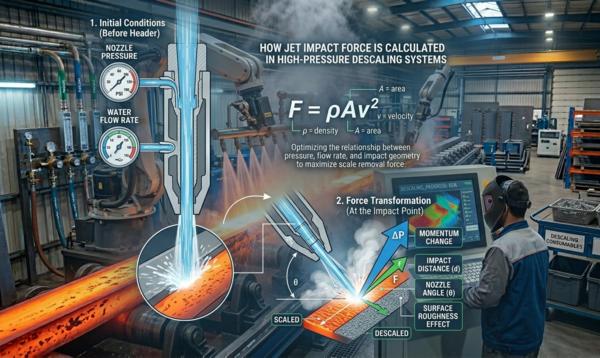
A pressure drop reduces jet velocity and impact force. When the water jet impact becomes weak, oxide scale may not break or lift from the steel surface.
This can cause:
- Uneven oxide scale removal
- Scale patches on the surface
- Rolled-in scale defects
- Poor surface finish
- Higher rejection and rework
- More roll wear
- Reduced rolling mill productivity
A reliable oxide scale removal system must maintain stable pressure to support smooth and consistent hot metal descaling system performance.
Common Causes of Pressure Drop in Descaling Systems
1. Blocked or Worn Nozzles
Blocked nozzles restrict water flow and disturb the spray pattern. Worn nozzles may increase flow beyond design limits, which can reduce effective pressure and create uneven impact.
Regular nozzle inspection is important for every rolling mill surface cleaning system.
2. Clogged Filters and Poor Water Quality
Dirty water can clog filters, nozzles, valves, and pipelines. When filters become blocked, pressure loss increases and the system may not deliver proper nozzle pressure.
Clean water and proper filtration are essential for a reliable industrial descaling system.
3. Pump Wear or Wrong Pump Selection
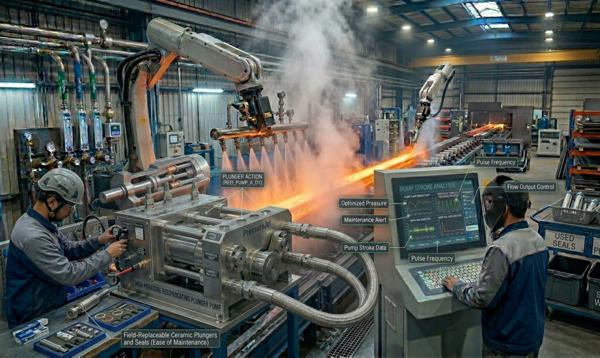
The pump is the heart of high pressure plunger pump descaling. If pump components are worn, the system may not generate the required pressure and flow.
Incorrect pump selection can also create unstable pressure, especially in continuous hot rolling mill operations.
4. Pipeline Losses and Undersized Piping
Long pipelines, small pipe diameters, sharp bends, and unnecessary restrictions can increase pressure loss. Even if pump pressure is high, poor piping design can reduce pressure at the descaling header.
This is especially important for heavy rolling mill descaling system and primary descaling system – rolling mill applications.
5. Valve Leakage or Malfunction
Leaking bypass valves, faulty pressure control valves, worn seals, or partially closed valves can cause pressure loss. Regular valve inspection helps maintain stable system pressure.
6. Air Entry or Suction-Side Problems
Air in the suction line can cause pressure fluctuation, pump vibration, and unstable performance. Poor water supply, loose fittings, or suction restrictions can also affect pump output.
Signs of Pressure Drop in a Descaling System
Rolling mills may notice pressure drop through visible performance issues such as:
- Weak spray pattern
- Uneven descaling
- More scale patches
- Reduced surface finish quality
- Pressure gauge fluctuation
- Pump vibration or noise
- Frequent nozzle blockage
- Increase in rolled-in scale defects
If these issues appear regularly, the scale removal system for steel should be inspected immediately.
Solutions to Reduce Pressure Drop
To reduce pressure drop, rolling mills should focus on both system design and maintenance.
Useful steps include:
- Inspect and replace worn nozzles
- Clean blocked nozzles regularly
- Maintain proper water filtration
- Check pump pressure and flow capacity
- Use correct pipe diameter
- Reduce unnecessary bends and restrictions
- Inspect valves, seals, and bypass lines
- Maintain proper suction conditions
- Monitor pressure at the pump and header level
Depending on the application, mills may require a 300 bar descaling system, 350 bar descaling system, or 400 bar descaling system. For difficult scale conditions, a heavy duty descaling system, severe scale removal system, or ultra high pressure descaling system may be required.
Pressure Drop Control for Different Rolling Mill Applications
Different rolling mill products need different pressure stability.
A billet descaling system needs strong and focused jet impact. A slab descaling system needs uniform pressure across a wider surface. A bloom descaling system needs stable force for heavy sections. A TMT bar descaling system needs continuous pressure for fast rolling lines.
For alloy steel descaling system and hot billet descaling system applications, pressure stability is even more important because scale may be harder, denser, and more difficult to remove.
PressureJet’s Approach to Stable Descaling Pressure
PressureJet designs descaling systems by considering the complete application, not only pump pressure. As a trusted descaling system manufacturer India and high pressure pump manufacturer India, PressureJet focuses on stable pressure, correct flow, nozzle impact, header design, and filtration.
PressureJet’s engineering approach includes:
- Pump capacity selection
- Flow rate calculation
- Nozzle selection
- Header layout
- Pipe sizing
- Filtration planning
- Pressure monitoring
- Application-based system design
For customers searching for rolling mill descaling Ahmedabad, descaling pump manufacturer Gujarat, or descaling system supplier India, PressureJet offers customized support for hot rolling mills and steel plants.
PressureJet also serves industrial users as a descaling system exporter and global descaling solution provider.
Facing Pressure Drop in Your Descaling System?
PressureJet provides customized high pressure descaling system solutions for billets, slabs, blooms, TMT bars, alloy steel, and hot rolling mill applications.
Contact PressureJet today to get an engineered descaling solution with stable pressure, correct flow, strong nozzle impact, and reliable oxide scale removal.