
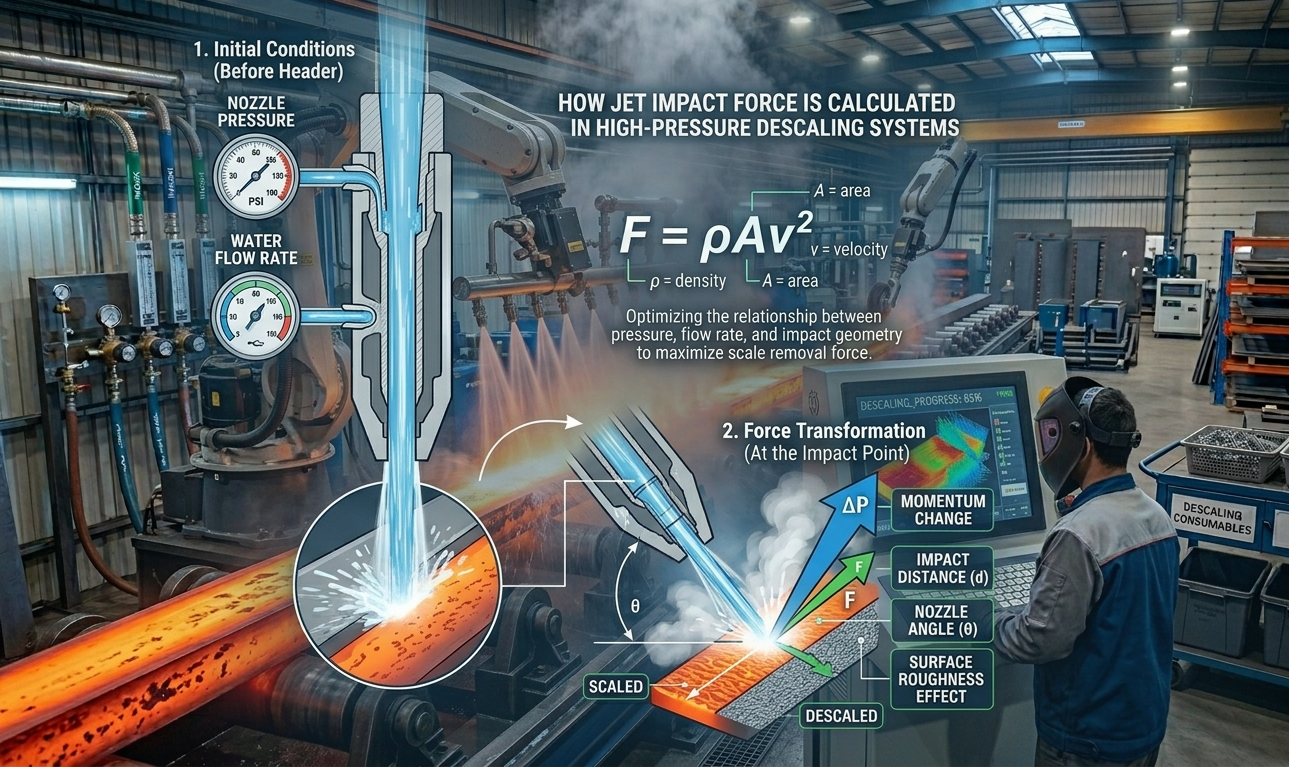
In hot rolling mills, oxide scale removal depends heavily on the force with which high-pressure water strikes the hot steel surface. This force is known as jet impact force.
A high pressure descaling system does not work effectively only because of pressure. The real descaling performance depends on pressure, flow rate, nozzle design, spray angle, stand-off distance, and impact area. When these factors are properly balanced, the water jet can break and remove oxide scale from billets, slabs, blooms, TMT bars, and hot metal surfaces more efficiently.
PressureJet specializes in engineered steel rolling mill descaling solutions where jet impact is optimized for better scale removal and surface quality.
What Is Jet Impact Force in Descaling?
Jet impact force is the force created when high-pressure water hits the hot steel surface. In a water jet descaling system, this force helps crack, lift, and remove oxide scale before the steel enters the rolling stands.
In simple terms, stronger and well-focused jet impact improves the performance of an oxide scale removal system. However, impact must be controlled. Too little impact may leave scale on the surface, while poor spray coverage may create uneven descaling.
A common way to understand impact intensity is:
Impact Intensity = Jet Force ÷ Impact Area
Or:
I = F / A
Where:
I = Impact intensity
F = Jet force
A = Impact area
This means the same force applied over a smaller area creates higher impact intensity.
Basic Formula for Jet Impact Force
A simplified engineering formula for jet impact force is:
F ≈ ρ × Q × V
Where:
F = Jet impact force
ρ = Water density
Q = Flow rate
V = Jet velocity
This formula shows that jet force depends mainly on how much water is flowing and how fast the water is moving.
Pressure helps increase jet velocity. Flow rate decides how much water volume reaches the surface. Nozzle design controls how that water is shaped and directed toward the steel.
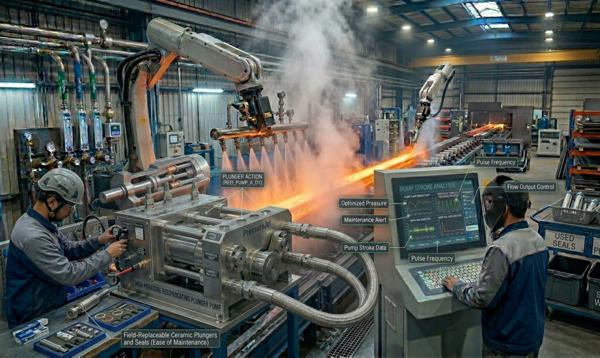
This is why high pressure plunger pump descaling must be designed with the right pressure, flow, and nozzle arrangement.
How Pressure Affects Jet Impact Force
Pressure is important because it increases the velocity of the water jet. Higher pressure can help break hard and tightly bonded oxide scale.
Depending on the rolling mill requirement, plants may use a 300 bar descaling system, 350 bar descaling system, or 400 bar descaling system. For demanding scale conditions, an ultra high pressure descaling system may be required.
However, pressure alone is not enough. If the nozzle size, spray angle, flow rate, or header position is wrong, even high pressure may not deliver effective scale removal.
How Flow Rate Affects Jet Impact Force
Flow rate is the amount of water delivered through the descaling nozzles. It plays an important role in carrying enough water to the steel surface and removing broken scale.
Low flow with high pressure may create strong impact in a limited area but may not clean the full surface properly. On the other hand, excessive flow may increase water usage and cooling without improving descaling efficiency.
A reliable industrial descaling system needs the right flow rate for product width, rolling speed, scale thickness, and nozzle arrangement.
Why Impact Area Matters
Impact area is the surface area where the water jet strikes the steel. If the jet force is concentrated in a smaller area, the impact intensity becomes higher. If the same force is spread over a wider area, coverage improves but intensity may reduce.
This is why nozzle selection is critical in a rolling mill descaling system. The system must balance impact strength and spray coverage.
For example, a slab descaling system needs wide and uniform coverage, while a billet descaling system may need more focused impact. A bloom descaling system may require heavy-duty impact for large sections, while a TMT bar descaling system needs efficient scale removal for continuous rolling.
Key Factors That Influence Jet Impact Calculation
Jet impact force is affected by several factors, including:
- Pump pressure
- Flow rate
- Nozzle size
- Spray angle
- Spray thickness
- Stand-off distance
- Header alignment
- Impact area
- Product temperature
- Rolling speed
- Scale thickness
For alloy steel descaling system or hot billet descaling system applications, these factors become even more important because scale can be dense, hard, and difficult to remove.
PressureJet’s Approach to Jet Impact Optimization
PressureJet focuses on complete descaling performance, not only pressure rating. As a trusted descaling system manufacturer India and high pressure pump manufacturer India, PressureJet designs systems based on actual rolling mill conditions.
PressureJet considers pressure, flow rate, nozzle impact, header position, spray coverage, product size, and scale condition before recommending a solution.
Its high pressure plunger pump descaling technology supports hot metal descaling system, hydraulic descaling system, metallurgical descaling system, and rolling mill surface cleaning system applications.
For customers searching for rolling mill descaling Ahmedabad, descaling pump manufacturer Gujarat, or descaling system supplier India, PressureJet provides customized solutions for Indian and global steel rolling mill requirements. PressureJet also supports customers as a descaling system exporter and global descaling solution provider.
Need the Right Jet Impact Force for Your Descaling System?
PressureJet provides customized high pressure descaling system solutions for billets, slabs, blooms, TMT bars, alloy steel, and hot rolling mill applications.
Contact PressureJet today to get an engineered descaling solution with the right pressure, flow rate, nozzle impact, and oxide scale removal performance.