
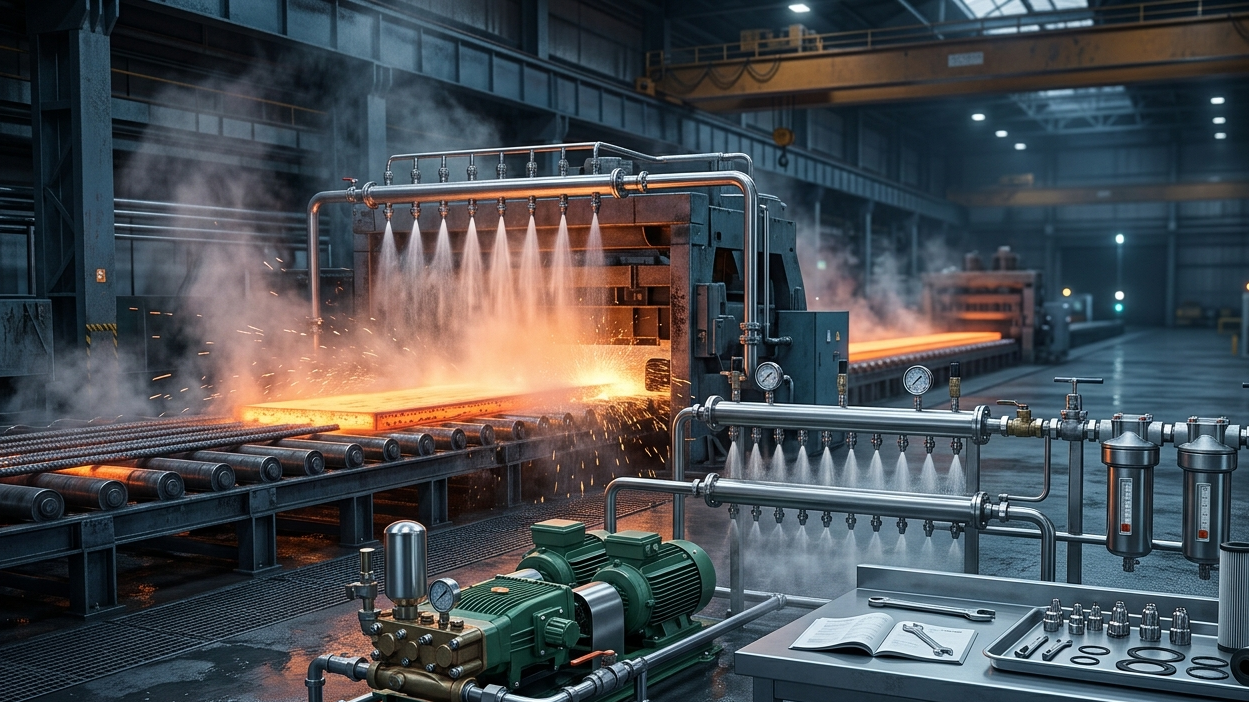
In hot rolling mills, descaling plays an important role in removing oxide scale from billets, slabs, blooms, TMT bars, and other hot steel products. When descaling is not done properly, scale can remain on the surface and get rolled into the steel, causing surface defects, poor finish, roll wear, and production losses.
A reliable high pressure descaling system helps rolling mills improve scale removal, protect product quality, and reduce downtime. However, even a good system can perform poorly if it is not designed, operated, or maintained correctly.
Here are the most common descaling mistakes in rolling mills and how to avoid them.
Mistake 1: Using Low or Inconsistent Water Pressure
One of the biggest mistakes is operating the rolling mill descaling system at low or unstable pressure. If the water pressure is not strong enough, the jet impact becomes weak and oxide scale may remain on the steel surface.
This can lead to rolled-in scale, rough finish, pits, and surface marks.
To avoid this, rolling mills should choose the right high pressure plunger pump descaling system based on scale thickness, product size, rolling speed, and application. Depending on the requirement, mills may need a 300 bar descaling system, 350 bar descaling system, or 400 bar descaling system.
Mistake 2: Wrong Nozzle Selection or Spray Angle
Nozzles play a major role in a water jet descaling system. Wrong nozzle size, spray angle, or impact pattern can result in poor coverage. Some areas may get over-sprayed, while others may remain untreated.
This is especially risky in billet, slab, bloom, and TMT bar rolling, where uniform scale removal is required.
To avoid this, select the correct nozzle design, spray angle, and header layout. Proper alignment helps deliver high impact water jet descaling and improves surface cleaning across the full steel width or section.
Mistake 3: Ignoring Nozzle Blockage and Wear
Blocked or worn nozzles are a common reason for poor descaling performance. Dust, scale particles, rust, or poor water filtration can reduce water flow and disturb the spray pattern.
Worn nozzles can also reduce impact force and create uneven descaling. This may lead to scale patches and visible surface defects.
To avoid this mistake, inspect nozzles regularly, clean blocked nozzles, replace worn nozzles, and maintain proper filtration. A good industrial descaling system needs regular nozzle checks to perform consistently.
Mistake 4: Incorrect Descaling Header Position
The position of the descaling header affects impact force and coverage. If the header is too far, too close, or incorrectly aligned, the water jet may not hit the surface effectively.
Incorrect header placement can leave oxide scale on the steel, especially near edges, corners, or curved sections.
To avoid this, the primary descaling system – rolling mill should be designed according to product type, temperature, speed, and scale condition. Correct header positioning is important for a hot billet descaling system, slab descaling system, bloom descaling system, and TMT bar descaling system.
Mistake 5: Using the Same Setup for Every Steel Product
Every steel product has different descaling requirements. A billet does not need the same spray pattern as a slab. A TMT bar does not need the same system layout as a bloom or alloy steel product.
Using one common setup for all products may reduce descaling efficiency.
To avoid this, the system should be matched to the product. Rolling mills should choose application-specific solutions such as:
- Billet descaling system
- Slab descaling system
- Bloom descaling system
- TMT bar descaling system
- Alloy steel descaling system
- Hot metal descaling system
This helps improve oxide scale removal and surface quality.
Mistake 6: Poor Water Quality and Filtration
Poor water quality can damage the descaling system. Dirty water may clog nozzles, damage valves, affect pump performance, and reduce the life of system components.
A hydraulic descaling system depends on clean water flow for stable pressure and proper spray impact.
To avoid this, maintain filtration systems, check water cleanliness, and remove debris from circulation lines. Better water quality supports better performance and longer equipment life.
Mistake 7: Lack of Preventive Maintenance
Many rolling mills wait for visible surface defects before checking the descaling system. This can lead to repeated quality problems, downtime, and higher maintenance costs.
Preventive maintenance should include inspection of:
- Pump pressure
- Nozzle condition
- Spray pattern
- Filters
- Valves
- Headers
- Pipelines
- Water quality
A well-maintained heavy duty descaling system helps reduce breakdowns and supports consistent steel rolling mill descaling performance.
How to Avoid Descaling Mistakes
To avoid common descaling problems, rolling mills should focus on correct system design, stable pressure, proper nozzle alignment, clean water, and regular maintenance.
The system should also be selected according to product type, steel grade, mill speed, and scale condition. For severe scale conditions, a severe scale removal system, extreme scale removal system, or ultra high pressure descaling system may be required.
Working with an experienced descaling system manufacturer India helps ensure the system is designed for real rolling mill conditions.
Why PressureJet for Rolling Mill Descaling?
PressureJet is a trusted descaling system supplier India and high pressure pump manufacturer India offering solutions for hot rolling mills and steel plants.
PressureJet specializes in high pressure plunger pump descaling systems for billets, slabs, blooms, TMT bars, alloy steel, and hot metal applications. For customers searching for rolling mill descaling Ahmedabad or descaling pump manufacturer Gujarat, PressureJet provides engineered descaling solutions with strong application knowledge.
PressureJet also supports customers as a descaling system exporter and global descaling solution provider for industrial descaling applications.
Want to Avoid Descaling Mistakes in Your Rolling Mill?
PressureJet provides customized high pressure descaling system solutions for billets, slabs, blooms, TMT bars, alloy steel, and hot rolling mill applications.
Contact PressureJet today to discuss your requirement and get the right descaling solution for better oxide scale removal, fewer surface defects, and smoother rolling mill performance.