

Excessive Pump Maintenance in Descaling Lines: Causes and Solutions
The Pump That Never Stops Needing Attention
Seal fails. Pressure drops. Line stops. Maintenance team strips the pump, replaces the parts, restores pressure — and the same sequence repeats two weeks later.
If this is your descaling system, you are not dealing with bad luck. You are dealing with a system problem.
Excessive pump maintenance in descaling lines is one of the most consistently reported operational frustrations among rolling mill managers across India. The spare parts cost accumulates quietly. The downtime disrupts production. And the root cause is rarely addressed — because nobody is looking in the right place.
Why Descaling Pumps Fail More Than They Should
A descaling pump operates under conditions that combine several aggressive factors simultaneously — continuous duty cycling, pressures between 120 and 400 bar, thermal shock from hot steel, and variable water quality. Any one of these would stress a pump. All four together accelerate wear at a rate most mills underestimate.
The Six Root Causes
1. Undersized pump A pump running at or beyond its rated capacity — because the original spec was wrong or production volumes increased — has no headroom. Every component runs at its limit permanently. Seals, valves, bearings, and plungers all wear faster than planned.
2. Wrong seal material or fit Standard rubber packing is not designed for continuous high-pressure cycling. PTFE V-ring packing with the correct retainer is the standard. Incorrect substitutions — common when buying spares locally — result in seals failing in days instead of months.
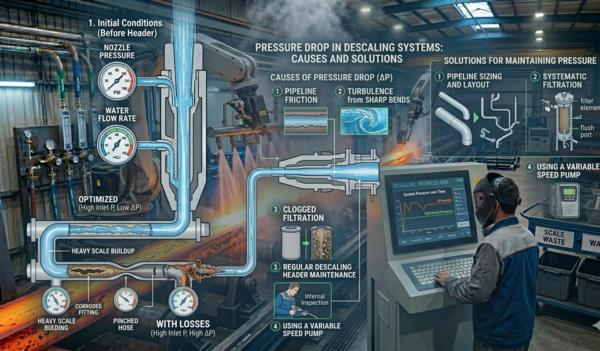
3. Valve wear from contamination Particles in the process water — scale chips, rust, sediment — pass through inadequate filtration and lodge on valve seating surfaces. Even microscopic particles prevent the valve from sealing. Partial sealing causes pressure loss and rapid valve face erosion.
4. Inadequate filtration The most neglected element in descaling system design. A 100-micron filter that is never cleaned eventually passes everything. A filter too coarse for your water quality allows particles that destroy valve seats and score plunger surfaces to reach the pump unchecked.
5. No VFD control Without a Variable Frequency Drive, the pump runs at fixed speed regardless of demand. When the descaling zone is inactive, pressure builds against a closed header — cycling the pressure relief valve continuously. Every cycle is a mechanical stress event on the entire pump.
6. Crankcase water ingress Minor packing leakage migrates toward the crankcase and contaminates the oil. Water in oil destroys lubrication. What began as a small seal issue becomes a bearing and crankshaft failure.
What It Actually Costs
The spare parts bill is visible. The real cost is not.
- Production lost during every unplanned stoppage
- Roll wear acceleration when the pump is down and billets roll unscaled
- Product defects produced during pump downtime
- Labour cost for emergency versus planned maintenance
In a mill running 300 days per year, two unplanned pump stoppages per month — each costing 2 hours — is 48 hours of lost rolling time annually. That is a measurable tonnage loss, not a maintenance line item.
Is Your System Due for a Review?
If your maintenance team is replacing seals and valves every few weeks — the system needs a review, not another spare parts order.
Ask these questions:
- Is the pump sized for your actual flow and pressure — not nominal values?
- Is the filtration system serviced on schedule and fine enough for your water quality?
- Has production increased since the pump was originally specified?
- Are you using OEM parts or local substitutes?
If any of these raises a concern — a technical audit will show you exactly where the problem starts and what it costs to fix versus what it costs to ignore.
Request a Free System Audit
PressureJet Systems has been engineering high-pressure descaling solutions for rolling mills across India and 50+ countries for over 30 years.
We review your existing system — pump condition, operating parameters, filtration, maintenance history — and give you a clear recommendation at no cost.
Key Takeaways
- Excessive maintenance is a system problem — not a parts problem
- The six causes are pump undersizing, wrong seals, valve contamination, poor filtration, no VFD, and water ingress
- Every cause has an engineering solution — the fix is known, it just needs to be applied
- Indirect costs of downtime far exceed the visible spare parts spend
- A free system audit is the fastest way to find where your system is losing money