
The Yield Problem Nobody Talks About
Ask any rolling mill plant head what drives rejection. The answer almost always points to the rolling process roll wear, pass design, billet temperature.
Rarely does the conversation reach the 3 seconds between furnace exit and first rolling pass.
That is where yield is often lost.
The moment a hot billet exits the furnace at 1100°C, oxide scale begins forming on its surface. If not removed before rolling, it gets pressed permanently into the steel showing up as surface defects, scale pitting, and embedded chips that drive rejection, rework, and quality complaints.
What Scale Actually Does to Your Steel
Most operators treat scale as a cosmetic issue. It is not.
When a scaled billet enters the rolling stand, two things happen:
Scale gets pressed into the bar surface. Rolling pressure embeds oxide particles deep into the steel appearing as dark pitting and surface marks on the finished product.
Scale abrades the roll groove. Oxide scale is harder than hot steel. Every scaled billet pass quietly grinds your roll grooves, shortening roll campaign life and increasing roll change frequency.
In sectional views of bars from plants without adequate descaling, dark inclusions are visible inside the bar cross-section scale carried through the entire rolling process and embedded within the material.
How Poor Descaling Drives Rejection
Surface defects drive customer rejection. In competitive markets, bars with visible scale pitting or burrs are rejected by customers who have access to cleaner alternatives. Every rejected tonne represents the full cost of melting, casting, reheating, and rolling with no revenue to show for it.
Rework adds cost without adding value. In a mill running 300–500 tons per day, even a 2% rework rate means 6–10 tonnes of rework daily. Multiplied across a year, the cost is significant.
Cobbles and stoppages reduce effective output. Scale chips accumulating at slitters and no-twist mill grooves cause vibration, jamming, and unplanned shutdowns cutting the tonnage your mill actually produces per shift.
How Proper Descaling Improves Yield
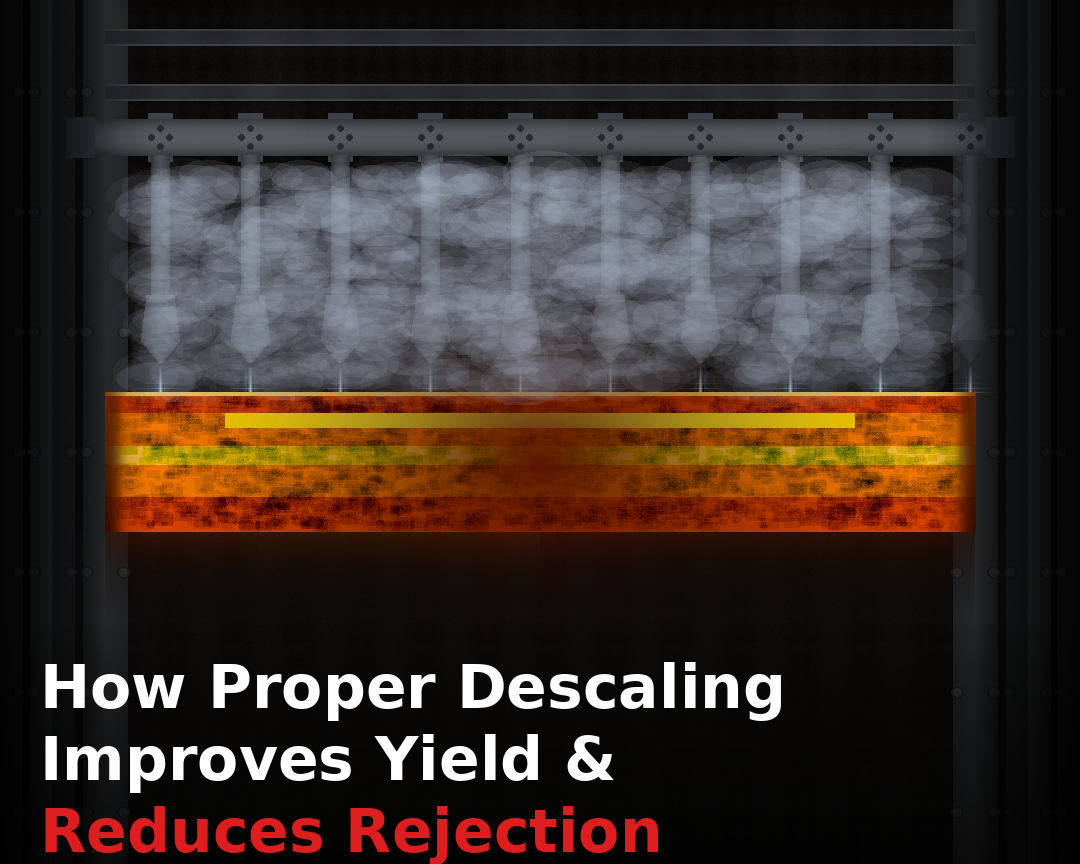
A high-pressure water jet descaling system removes scale from all four sides of the billet simultaneously before the first rolling pass. Operating at 120–250 bar, water jets fracture and flush scale away completely.
What enters the rolling stand is a clean, scale-free billet. The process works on steel not on a layer of hard oxide.
Fewer defects → less rejection. Clean billets produce clean bars. No embedded particles, no surface pitting, no burrs. Dimensional accuracy improves because metal fills the pass groove consistently.
Less rework → better yield. Bars that previously failed quality checks now pass at first inspection. The percentage of input material becoming sellable product rises directly.
Reduced roll wear → lower maintenance cost. With scale abrasion eliminated, roll groove wear slows significantly. Rolls last longer, campaigns produce more tonnage, and maintenance frequency drops.
At a live Fe 550D TMT plant 500 tons per day after PressureJet system installation:
- Surface defects and burrs completely eliminated
- Roll life extended significantly
- Approximately 1 hour saved per production cycle
Why Pump Quality Determines Everything
Not all descaling systems deliver these results. Performance depends on the pump.
A pump that cannot hold stable pressure delivers inconsistent jet impact — some billet sections fully descaled, others not. Yield improvement only materialises when pressure is stable and coverage is complete across all four sides.
Pumps that require frequent maintenance — seal failures, valve replacements become a source of production interruption rather than reliability. Every pump downtime event means scaled billets re-entering the rolling stand.
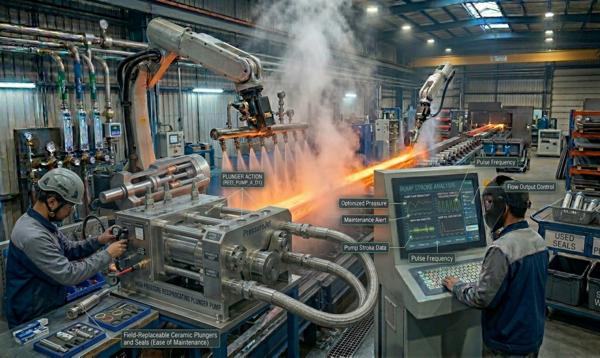
A purpose-built high-pressure triplex plunger pump, engineered for continuous hot mill duty, maintains reliable output with minimal maintenance — protecting both the production schedule and the yield gains the system was installed to deliver.
Is Your Current System Performing?
Many mills have a descaling system. Not all are delivering adequate performance. Ask:
- What pressure is the system actually running at during operation?
- When were nozzles last inspected — are any blocked or worn?
- How often is the pump requiring maintenance shutdowns?
- Are surface defects still a source of rejection despite descaling?
- When was the system last reviewed against current billet sizes and rolling speeds?
If any of these questions surface concerns, the system may not be giving your mill the yield protection it was designed to provide.
The Cost of Doing Nothing
The financial case for proper descaling is straightforward. The costs it eliminates are real and recurring:
- Rejection and rework every shift that surface defects appear
- Accelerated roll replacement from scale abrasion
- Production time lost to cobbles and guide jams
- Energy cost of reheating reworked material
Each of these costs is silent and compounding. A mill not addressing its descaling performance is paying them every day without recognising the source.
Request a Free System Audit
The fastest way to quantify the yield improvement available at your mill is a focused technical review — pressure, flow, nozzle condition, pump performance, and coverage pattern assessed against your current production requirements.
PressureJet Systems has been engineering high-pressure descaling solutions for rolling mills across India and 50+ countries for over 30 years.
We offer a free, no-obligation system review.
📞 +91 93139 22759 📧 descaling@pressurejet.com 🌐 www.pressurejet.com
Key Takeaways
- Scale forms within seconds of a billet leaving the furnace — if not removed before rolling, it causes permanent surface defects
- Poor descaling is a primary root cause of rejection, rework, roll wear, and production stoppages
- Proper high-pressure descaling improves yield, reduces rejection, and extends roll life simultaneously
- Documented at a live Fe 550D TMT plant: defects eliminated, roll life extended, ~1 hour saved per cycle
- Pump quality determines system performance — inconsistent pressure means inconsistent results
- A free system audit is the fastest way to understand what your current setup is costing you
PressureJet Systems Pvt. Ltd. | Pirana, Ahmedabad, Gujarat — 382427 | www.pressurejet.com