
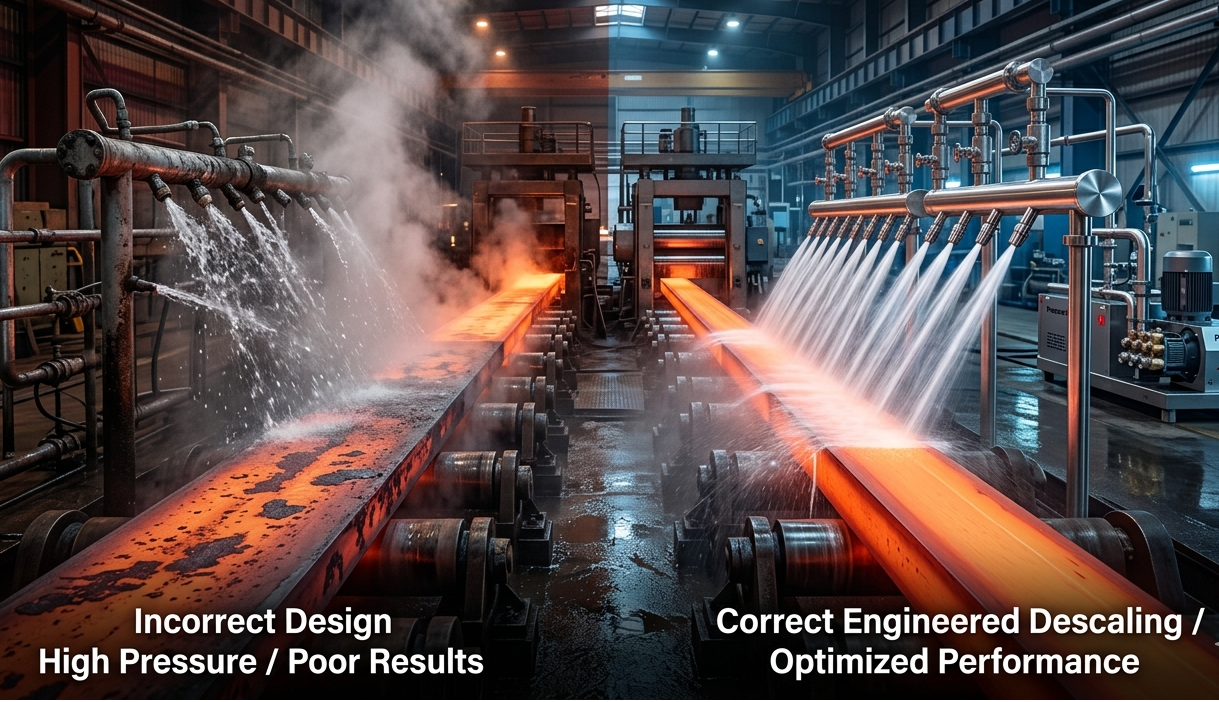
In hot rolling mills, many people assume that higher pressure always means better descaling. While pressure is important, it is not the only factor that decides descaling performance.
A good high pressure descaling system depends on the right balance of pressure, flow rate, nozzle design, spray angle, stand-off distance, header alignment, and scale condition. If these factors are not properly matched, even a very high-pressure system may fail to remove oxide scale effectively.
PressureJet specializes in engineered steel rolling mill descaling solutions where the focus is not just on higher pressure, but on the right pressure for the right application.
Why Pressure Alone Is Not Enough
Higher pressure can increase water jet velocity, but that does not automatically mean better oxide scale removal. If the nozzle selection is wrong, the spray angle is incorrect, or the header is not properly positioned, scale may remain on the steel surface.
In some cases, using excessive pressure without proper system design can increase energy consumption, water usage, component stress, and maintenance needs.
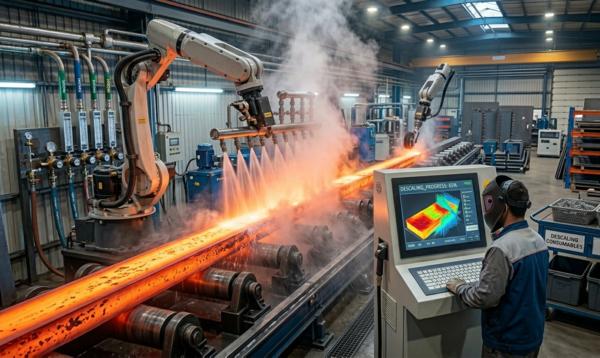
A reliable rolling mill descaling system should be designed to create strong and uniform water jet impact across the hot steel surface. This is what helps remove scale effectively before rolling.
What Actually Improves Descaling Efficiency?
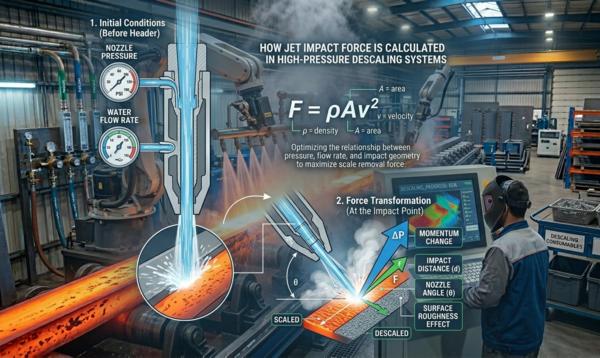
1. Water Jet Impact: Real descaling performance depends on how strongly the water jet strikes the steel surface. Impact force is more important than simply looking at the pressure rating.
A properly designed water jet descaling system ensures that water hits the hot metal surface with enough force to break and remove oxide scale.
2. Flow Rate: Flow rate is also important. High pressure with insufficient flow may not remove broken scale properly from the surface. The system must deliver enough water volume to support effective scale removal.
3. Nozzle Design: Nozzle size, spray pattern, spray thickness, and spray angle directly affect the result. Poor nozzle selection can create uneven cleaning, leaving scale patches on billets, slabs, blooms, or bars.
4. Stand-Off Distance: The distance between the nozzle and the hot steel surface matters. If the nozzle is too far away, impact force reduces. If it is too close, spray coverage may become poor.
5. Header Position and Alignment: Header layout and alignment decide how evenly the water jet covers the steel surface. Misaligned headers can leave untreated areas and reduce descaling efficiency.
When Higher Pressure Can Help
Higher pressure can be useful when oxide scale is thick, hard, or strongly attached to the steel surface. It may be required for heavy rolling mills, hot billets, slabs, blooms, alloy steel, and severe scale conditions.
Depending on the application, rolling mills may need a 300 bar descaling system, 350 bar descaling system, or 400 bar descaling system. For very difficult scale removal, an ultra high pressure descaling system or heavy duty descaling system may be suitable.
However, higher pressure works best only when it is combined with correct nozzle design, proper flow, and accurate system layout.
When Higher Pressure May Not Improve Results
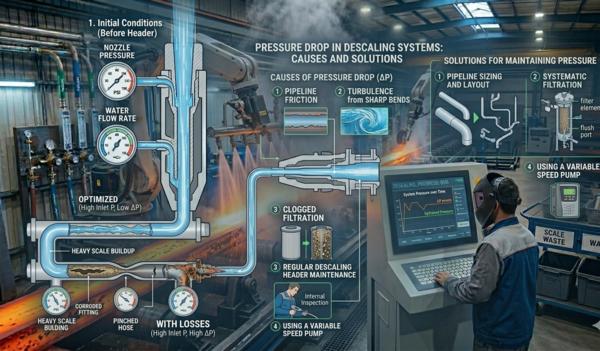
Higher pressure may not improve descaling if the basic system conditions are wrong. Common reasons include:
- Incorrect nozzle selection
- Poor spray angle
- Excessive stand-off distance
- Low water flow
- Header misalignment
- Blocked or worn nozzles
- Poor water filtration
- Scale condition not matching system design
- Lack of preventive maintenance
This is why a scale removal system for steel must be engineered properly instead of simply increasing pump pressure.
Right Pressure for Different Rolling Mill Applications
Different steel products require different descaling approaches. A billet descaling system may need a different nozzle setup than a slab descaling system. A bloom descaling system may require strong impact for heavy sections, while a TMT bar descaling system needs efficient cleaning for continuous bar rolling.
Similarly, an alloy steel descaling system may need special attention because alloy steels can form dense oxide layers. For a hot billet descaling system or hot metal descaling system, pressure, flow, nozzle angle, and header position must work together.
The right descaling system is not the one with the highest pressure. It is the one that removes scale efficiently with the best balance of performance, energy use, and reliability.
PressureJet’s Approach: Right Pressure, Right Design
PressureJet focuses on complete descaling performance. As a trusted descaling system manufacturer India and high pressure pump manufacturer India, PressureJet designs systems based on real rolling mill requirements.
PressureJet considers:
- Product type
- Scale thickness
- Rolling speed
- Required pressure and flow
- Nozzle arrangement
- Header position
- Pump capacity
- Water quality
- Maintenance needs
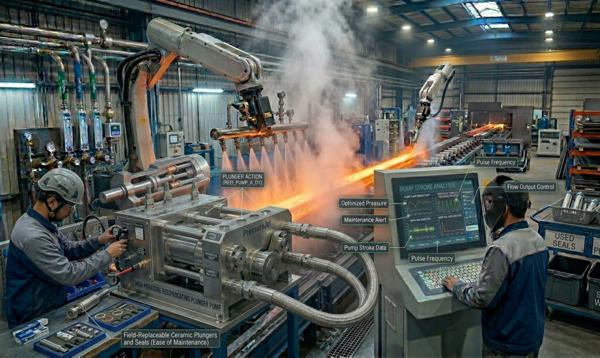
PressureJet’s high pressure plunger pump descaling technology supports applications such as industrial descaling system, metallurgical descaling system, hydraulic descaling system, and rolling mill surface cleaning system requirements.
For customers looking for rolling mill descaling Ahmedabad, descaling pump manufacturer Gujarat, or descaling system supplier India, PressureJet offers customized solutions for hot rolling mills and steel plants. PressureJet also supports international requirements as a descaling system exporter and global descaling solution provider.
Need the Right Descaling Pressure for Your Rolling Mill?
PressureJet provides customized high pressure descaling system solutions for billets, slabs, blooms, TMT bars, alloy steel, and hot rolling mill applications.
Contact PressureJet today to get an engineered descaling solution with the right pressure, flow, nozzle impact, and scale removal performance.