

Hot rolling mills operate in one of the harshest metallurgical environments in the steel industry. Billets, blooms, and slabs are reheated to temperatures typically ranging from 1,050 °C to 1,250 °C before they enter deformation zones. At these temperatures, steel reacts rapidly with oxygen present in the furnace atmosphere, forming oxide scale on the surface.
This scale is unavoidable.
What is avoidable is allowing that scale to enter the rolling stands.
Hot steel descaling is the process of removing this oxide layer using high-pressure water jets immediately before rolling. It is a critical operation across long product mills, bar mills, wire rod mills, structural mills, plate mills, and TMT rolling mills.
Organizations such as PressureJet Systems Pvt. Ltd. are well known in the industry not simply for manufacturing high-pressure pumps, but for deeply understanding the physics, metallurgy, and operating constraints of hot steel descaling applications.
How Oxide Scale Forms in Hot Rolling Operations?
When steel is heated above approximately 700 °C, oxidation begins. At reheating furnace temperatures, this reaction accelerates and produces a multi-layered oxide structure:
- Wüstite (FeO) – inner layer, relatively soft
- Magnetite (Fe₃O₄) – intermediate layer, dense and hard
- Hematite (Fe₂O₃) – outer layer, brittle
The thickness and adhesion strength of scale depend on:
- Furnace temperature profile
- Oxygen potential
- Residence time
- Steel chemistry (carbon and alloy content)
Alloy steels typically form thicker and more adherent scale compared to mild steel, making descaling more demanding.
Why Oxide Scale Is a Serious Rolling Mill Problem?
If scale is not removed before rolling, it creates multiple downstream issues:
1. Surface Defects on Finished Products
Scale trapped between rolls and steel becomes pressed into the surface, causing pits, laps, seams, and cracks. In long products, this directly impacts visual quality and mechanical integrity.
2. Accelerated Roll Wear
Oxide scale is significantly harder than the base steel. When it enters the roll gap, it behaves as a third-body abrasive, embedding into roll surfaces and initiating micro-fatigue cracks. This shortens roll life and increases grinding frequency.
3. Unstable Rolling Conditions
Scale alters friction unpredictably. This leads to billet slippage, torque fluctuations, load instability, and inconsistent deformation—especially problematic in roughing and intermediate stands.
4. Increased Rejection and Rework
Surface-related defects account for a major percentage of rejections in bar, section, and wire rod mills. Poor descaling directly increases rejection rates and customer complaints.
On the shop floor, these combined effects are often referred to as “mill garbage”—a mixture of scale, burs, metallic fines, and debris that compromises productivity.
What Is Hot Steel Descaling?
Hot steel descaling is a hydro-mechanical process that uses high-pressure water jets to:
- Break the bond between oxide scale and steel surface
- Mechanically lift and fracture the scale
- Flush dislodged scale away from the rolling path
Unlike chemical pickling or abrasive methods, hydro-mechanical descaling:
- Operates in real time
- Does not alter steel chemistry
- Does not damage the base metal
- Is compatible with continuous rolling operations
Typical Descaling Pressure Ranges in Rolling Mills
Descaling pressure is selected based on steel grade, billet size, and mill layout:
- Mild steel: 200–250 bar
- Alloy steel: 250–300 bar
- High-strength and special alloys: up to ~300 bar
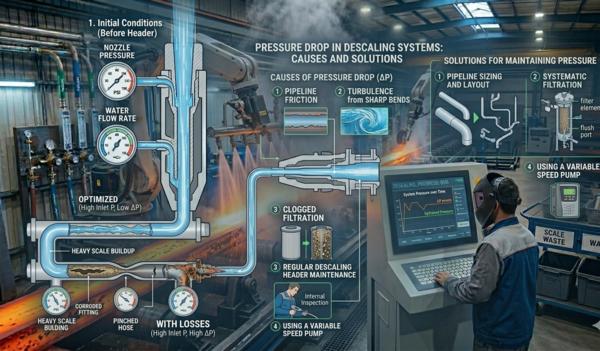
Pressure alone does not guarantee performance. Effective descaling depends on maintaining pressure at the nozzle, combined with correct flow rate and jet geometry.
PressureJet systems are engineered to deliver stable pressure and volumetric efficiency at the point of impact—not merely at the pump outlet.
The Physics Behind High-Pressure Water Jet Descaling
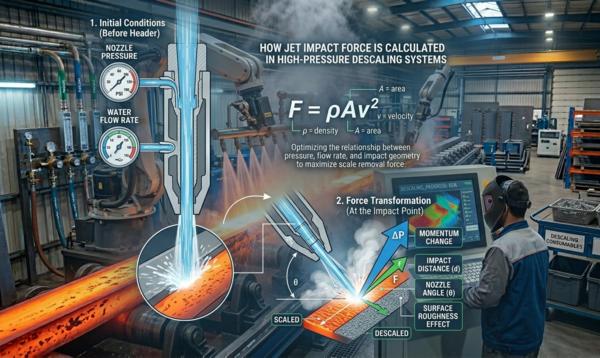
Descaling works through impingement force, not washing action.
When a high-velocity water jet strikes hot steel:
- Thermal shock weakens the oxide-metal interface
- Jet momentum penetrates micro-cracks in the scale
- Mechanical force fractures and lifts the oxide layer
- Scale is removed in flakes and flushed away
For alloy steels, higher pressure is required because the oxide layer exhibits greater adhesion strength. At around 300 bar, jet velocity and impact force exceed the bonding strength of dense oxide layers.
Key parameters that govern effectiveness:
- Jet pressure and velocity
- Flow rate per unit width
- Nozzle orifice size and spray angle
- Stand-off distance and jet overlap
This is why descaling systems must be application-engineered, not standardized.
Importance of Flow Rate Matching to Billet Size
A common misconception is that increasing pressure alone improves descaling. In practice, flow rate must be matched to billet or slab dimensions.
- Smaller sections require focused, coherent jets
- Larger sections require wider coverage and higher total flow
If flow is insufficient:
- Scale cracks but remains on the surface
- Broken scale re-enters the roll gap
If flow is excessive:
- Billet temperature drops
- Rolling energy consumption increases
- Metallurgical control becomes difficult
PressureJet designs descaling headers so that pressure and flow operate together, ensuring effective scale evacuation without unnecessary thermal loss.
Why Hot Steel Descaling Is Critical Across All Rolling Mills?
Hot steel descaling is essential for:
- Bar and rod mills
- Structural and section mills
- Wire rod mills
- Plate and strip mills
- Alloy and special steel mills
- TMT Mill
In every case, descaling directly influences:
- Surface quality
- Roll life
- Process stability
- Yield and productivity
Mills that treat descaling as a utility often struggle with chronic quality and maintenance issues. Mills that treat it as a core process system achieve more stable and predictable operations.
Descaling and Roll Life: A Direct Relationship
Roll damage is rarely caused by average rolling loads. It is caused by localized stress concentrations initiated by hard inclusions—most commonly oxide scale.
Effective descaling:
- Prevents scale entry into roll gaps
- Reduces abrasive and adhesive wear
- Slows fatigue crack initiation
In real rolling mill conditions, properly engineered descaling systems have consistently delivered 20–30% improvement in roll life, reducing both consumable costs and downtime.
Key Components of a Hot Steel Descaling System
A reliable descaling system typically includes:
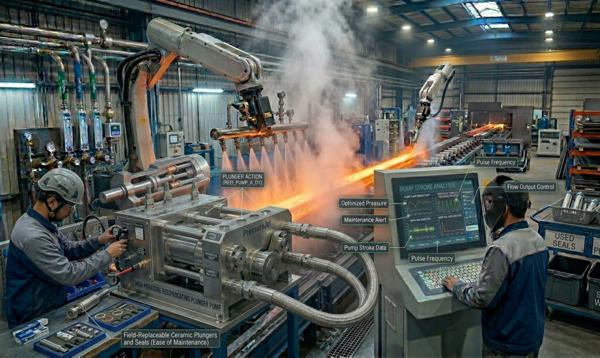
- High-pressure plunger pump
- Booster pump ensuring stable suction conditions
- Multi-stage filtration to protect nozzles
- Precision-engineered descaling headers
- High-velocity descaling nozzles
- Fast-acting pneumatic or hydraulic on-off valves
- Automation linked to billet tracking
PressureJet systems are recognized in the industry for integrating these elements into a single, reliable operating package, designed for continuous rolling environments.
Why Descaling Performance Degrades Without Maintenance?
Even well-designed systems lose effectiveness if not maintained.
Common degradation points include:
- Nozzle orifice erosion reducing jet velocity
- Valve guide wear causing delayed jet timing
- Booster pump filter clogging leading to pressure fluctuations
- Seal wear reducing volumetric efficiency
Experienced mills monitor:
- Actual nozzle pressure
- Flow consistency
- Filter differential pressure
- Pump efficiency trends
Preventive maintenance ensures that descaling performance remains consistent year after year.
Why the Industry Trusts PressureJet?
PressureJet is widely respected because it approaches descaling as an engineering application, not just equipment supply.
Its systems are designed with:
- Deep understanding of rolling mill operations
- Proven field experience across steel grades
- Emphasis on reliability, serviceability, and efficiency
This application-driven approach is why PressureJet descaling systems are trusted in demanding rolling mill environments.
Contact our experts today for a customized descaling audit.
- Visit: www.pressurejet.com
- Specialized Portal: www.steeldescaling.com